Someone Is Going to Lose › Notes › One
NotesOne · The Office Boy
These are the notes as printed in the November 2026 edition. Links to the sources will be added to this page as they are checked; new events since the reporting ended on November 4, 2026 are on the updates page.
Insull’s speeches are cited from Public Utilities in Modern Life: Selected Speeches (1914–1923) (Chicago, 1924), which says the texts were condensed; his 1881 letter and his 1910 recollections from Central-Station Electric Service: His Public Addresses, 1897–1914, ed. William E. Keily (Chicago, 1915).
- The epigraph, “I was quite ‘sot up’ at the idea that I was to become an electric financier”: Insull, Pearl Street fortieth-anniversary dinner, Hotel Commodore, New York, September 11, 1922, with Edison present.
- The copybook, the ruler, “In that particular case I was forced to embrace an opportunity,” Pitman’s shorthand, “sixteen or seventeen,” Dean Stanley, Spurgeon’s Tabernacle, Gladstone and “it was not quite as good as when it was delivered, but still it passed,” the dummy set of books, “a boy of nineteen”: Insull, speech to Electra, Edison Building, Chicago, January 15, 1920. “Forty-five years later”: the author’s calculation.
- The sacking at “nineteen or twenty,” the hundred pounds a year, “apple-pie order,” “My pride was hurt as it never was hurt before,” “I have never forgiven that man”: the same speech, which gives the partner’s words directly; the page paraphrases them. “Five dollars a week” is Insull’s own conversion.
- The advertisement for “bookkeeping and exchange,” January 1879, three times the salary, the books in “four or five different currencies,” “burn the midnight oil”: the same speech. In 1922 Insull told it differently, saying he got the job by offering to work for less than anyone else, about $7.50 a week; the page follows the 1920 account.
- Colonel George E. Gouraud: Keily’s note to the 1881 letter. That the London business was the telephone: Insull, September 11, 1922, and Elks’ Club, Chicago, October 24, 1919.
- The Bell injunction, “we thought we were about done,” the new receiver “within a month or so,” the “pretty wild” experts, Shaw in the battery room, the magazine article that sent gas shares down, “I would very much like to be associated with such a man”: Insull, September 11, 1922.
- Johnson’s dictated letter, “I was not getting any pay for this,” “The young Englishman to whom I am dictating this letter should be Edison’s private secretary,” the cable of January 1881: Insull, January 15, 1920. In 1910 he said the letter went to Uriah Painter in Washington and on to Menlo Park.
- The City of Chester, the back room, the walnut desks, Edison’s clothes, “an eye that was as keen and acute as any I have ever had focused upon me,” the Arizona at five, “between four and five in the morning”: Insull in Dyer and Martin (1910), vol. I, ch. xiv, as reprinted by Keily, and Elks’ Club, October 24, 1919. The 1910 text gives March 1; Keily’s note, from Insull’s letter to his mother, corrects it to February 28, 1881. The side-whiskers: Evening Post (Wellington), November 19, 1932; one outlet.
- The wallet, “$78,000 to his credit at Drexel, Morgan & Company,” the list of European telephone rights, and “ready to back his own judgment with his own money”: Insull, September 11, 1922. “Four o’clock the next morning”: Elks’ Club, 1919.
- Menlo Park in the snow and “an atmosphere of doubt; in fact, more than doubt — of derision”: Insull at Yale, April 5, 1916. The telegram, “three-quarters of a mile,” and “to pull the long bow”: Elks’ Club, 1919.
- “You ask me about Electric Light,” the 700 lights, eight miles of mains, “about 15,000 lights to each square mile,” “the most ingenious and yet the simplest thing imaginable,” “earning money by night and by day alike,” “about 15,650 lights,” “then you [will] see what you will see,” and “I have got right in with Edison”: Insull to J. E. Kingsbury, Menlo Park, May 1, 1881, printed in Keily, pp. xxxv–xxxix; the bracketed word is Keily’s. “It took sixteen”: the author’s calculation.
- Edison’s chemical meter: The Henry Ford museum, “Electricity? I’ll Take a Pound…,” and its catalog entry for an Edison chemical meter, about 1882.
- “I did whatever he told me … from buying his clothes to financing his business,” signing Edison’s name, the power of attorney and checks, “Yes” or “No” in the margin: Insull in Dyer and Martin (1910), vol. I, p. 368, reprinted by Keily. The power of attorney of July 27, 1881: Thomas A. Edison Papers, Rutgers, catalog.
- The patent company’s refusal to manufacture: Insull, September 11, 1922. Goerck Street, the Electric Tube Company at 65 Washington Street, Kruesi, the pipe and the window: Dyer and Martin reprint, pp. xxx–xxxi. “A thousand lamps a day”: the Kingsbury letter.
- Lamps at 35 cents that cost “from $1 to $1.50,” and “It was ‘some financing’”: Insull, September 11, 1922.
- Pearl Street, September 4, 1882: Morgan’s office, the dynamos at about three, the lamps at about five, “one of the busiest places down town” (The New York Times, September 5, 1882), about 400 lamps and some eighty-odd customers, capacity 7,200: Carl Sulzberger, “Thomas Edison’s 1882 Pearl Street Generating Station,” IEEE History Center. Insull in 1922 said about 59 customers. No charge until early 1883: Thomas A. Edison Papers. Morgan’s house lights from June 1882: The Morgan Library & Museum.
- “The first million dollars … paid a dividend,” “24 years after gas was first introduced,” “very difficult to raise money,” “the doubt that people had as to the commercial possibilities”: Elks’ Club, 1919. The twenty-four years for gas is Insull’s figure and has not been checked.
- The payroll night, as the page gives it, with “Do you think we can get enough money to reduce these debts some?”: Elks’ Club, 1919, dated there “about the year 1884 or 1885.” The second version, “Sammy, do you think that you can earn a living again as a stenographer?”: September 11, 1922, dated there “I should think it was in 1883.” Both tellings are Insull’s own.
- Lathes on the sidewalk, the strikes, the move to Schenectady in 1886 with about 200 men, the ten acres of the failed McQueen locomotive works, the growth to about 800: Wikipedia, “Edison Machine Works,” citing its own sources. Kruesi as principal assistant: Insull at Yale, 1916. “Mr. Insull was then my business manager, running the whole thing”: Edison, in Dyer and Martin (1910), vol. I, p. 382.
- Adams Street “started on August 6, 1888”: Insull, Western Society of Engineers, February 1, 1923. The sixty-day guarantee, Robert T. Lincoln, “there was not any object in discussing it,” “I think that was the meeting that established the very close relations,” and the two years without a president: Insull, University Club dinner, Chicago, September 20, 1922.
- Edison General Electric, April 24, 1889, Villard president: Thomas A. Edison Papers; Wikipedia. “Both Mr. Insull and I were afraid we might get in trouble for lack of money … so we sold out for a large sum”: Edison, in Dyer and Martin, as above. Second vice-president: Insull, September 20, 1922.
- Coffin’s twenty years in shoes and the 1883 call: Wikipedia, “Charles A. Coffin,” citing Hammond (1941) and Passer (1953). “Used to throw cold water”: Insull at Pittsfield, March 14, 1917. Thomson-Houston earning nearly twice as much: Mark Essig, Edison and the Electric Chair (2003), ch. 22, and Time, “Let There Be Light”; not checked against Passer.
- “Toward the end of 1891 negotiations took place,” and “On the day I was elected, I notified Mr. Coffin that I did not wish to serve longer than suited the convenience of the new company”: Insull, September 20, 1922.
- The February 1892 terms, $18 million of new stock to Thomson-Houston’s holders against $15 million to Edison General’s, Coffin president, Villard out, Morgan and Edison on the board: Jean Strouse, Morgan: American Financier (1999), p. 313, as cited by Wikipedia; not checked against Strouse. Organized April 15, 1892: Thomas A. Edison Papers.
- That Edison was not told until the day of the announcement, and Tate’s recollection that he would do something “so much bigger” that people would forget his name: Essig and Time, drawing on Alfred O. Tate, Edison’s Open Door (1938); not checked against Tate. The ore venture: IEEE, “Edison and Ore Refining.” That some blamed Insull, and his reasoning: John F. Wasik, The Merchant of Power (2006), pp. 51–52, as cited by Wikipedia. The obituaries’ version: Associated Press, July 16, 1938, as cited by Wikipedia; not checked against the original.
- The letters to Byron L. Smith and Edward L. Brewster, Gorton’s invitation, “The fact is that I nominated myself for that position,” “$750,000 of stock and $133,000 of bonds,” “about 30 percent of what I had been making,” “to cut off 70 percent of his income,” the three-year contract, “every other week,” July 1, 1892, the secretary who asked for five or ten dollars more, the friend’s “If Sammy wants you badly enough he will pay you more money,” “I generally treat him the same way I treated that young man,” and “$250,000 … mainly in the building of the annex to the Adams Street station”: Insull, September 20, 1922.
- “Thirty-two” and “eleven years with Edison”: the author’s calculation from his birth on November 11, 1859.
- Insull’s 1934 memoirs (published 1992) and his 1909 reminiscences in the Edison Papers tell these years again and were not read for this chapter.
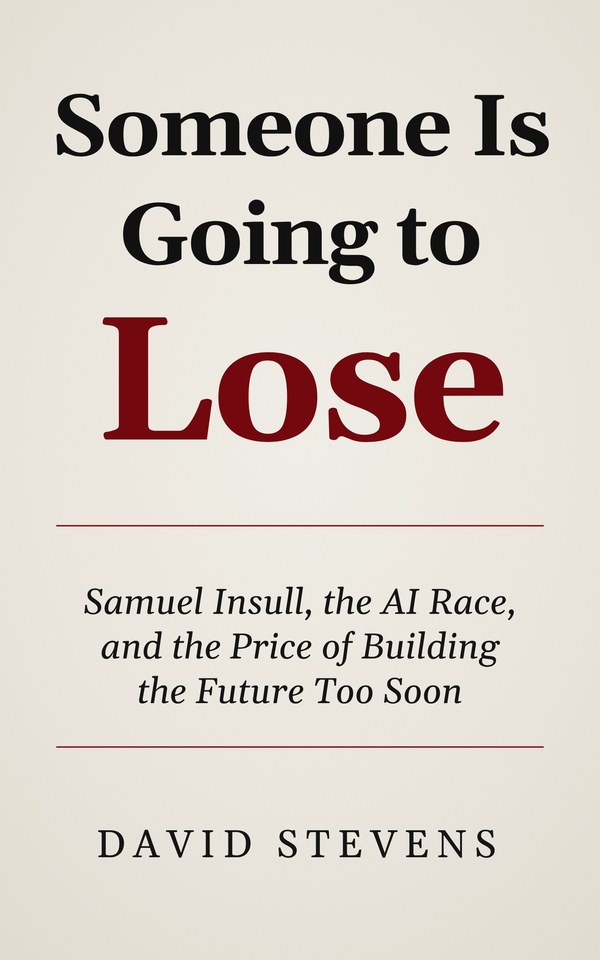
The book
Someone Is Going to Lose: Samuel Insull, the AI Race, and the Price of Building the Future Too Soon. In paperback, hardback and for Kindle.
View on AmazonAll the notes