The short answer
Not in a cell. He was sentenced to imprisonment, but it was served in comfortable houses, and for the last eight years of his life in his own, outside Florence, under orders not to leave it.
During the trial
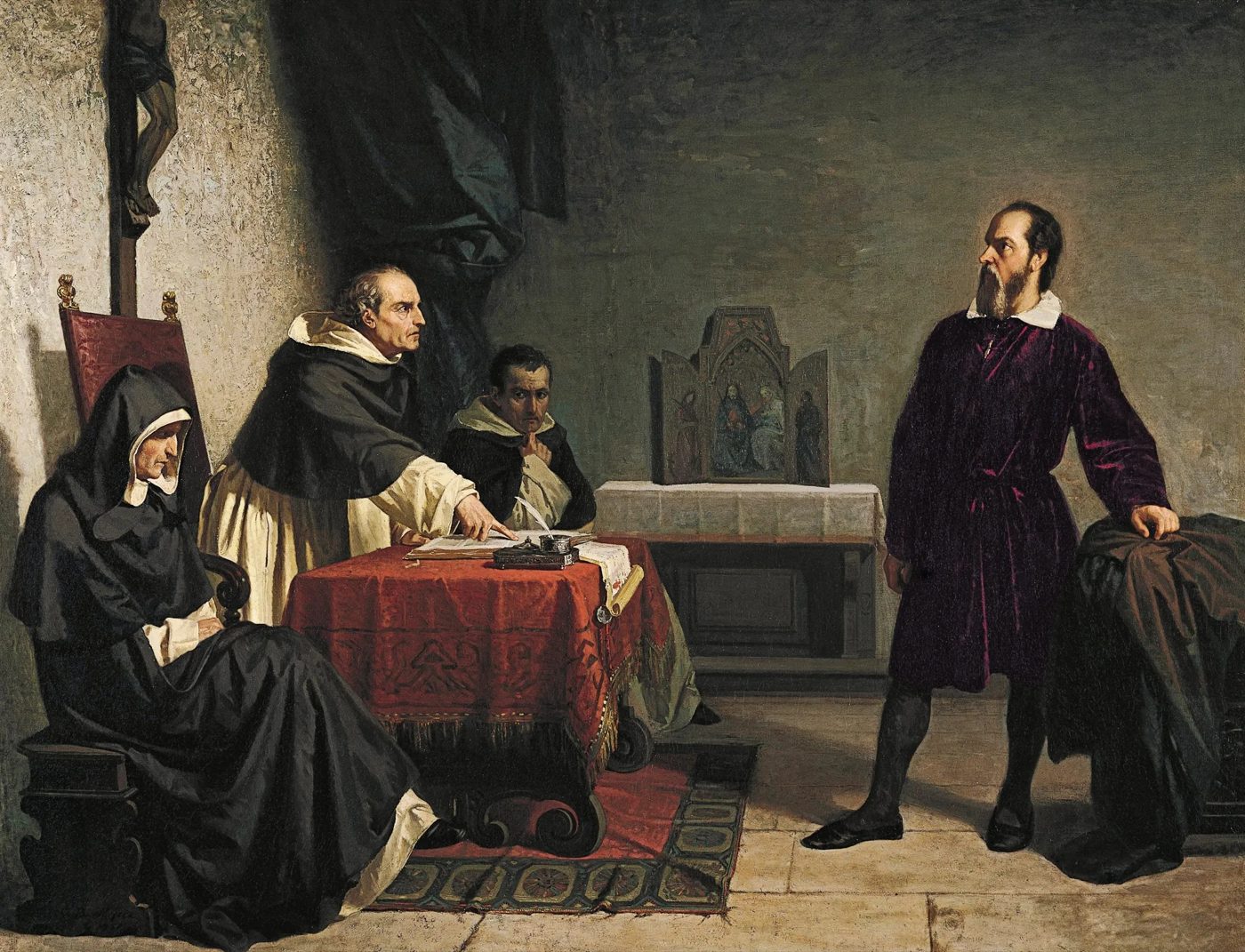
He arrived in Rome in February 1633 and lodged at the Tuscan embassy. For eighteen days in April, while he was being examined, he lived inside the Holy Office itself, but in the Fiscal's own quarters, not the cells, with his own servant and his dinner carried up from the embassy. The ambassador wrote home that there was no precedent for it. At the end of April he was sent back to the embassy in place of a prison.
After the sentence
He was first confined at the Grand Duke of Tuscany's villa in Rome, then sent to Siena, to the Archbishop, Ascanio Piccolomini, who treated him as a guest. In December 1633 he was allowed home to Arcetri, outside Florence, near the convent where his elder daughter, Sister Maria Celeste, was a nun. She died there four months later, aged thirty-three.
He lived at Arcetri for the rest of his life, going blind, under orders not to leave without permission, and finished his greatest work of physics there. He died on 8 January 1642.
Where the dungeon came from
In 1874 John William Draper's History of the Conflict between Religion and Science had Galileo sent to prison and treated with cruel severity for the rest of his life. It was a bestseller, and it fixed the version most of us still carry.
This site is not connected with the Broadway production of Galileo.