Most of us carry the same story about Galileo. A scientist proves that the earth goes round the sun. The Church refuses to look through his telescope, puts him on trial, shows him the instruments of torture, and makes him take it back. As he rises from his knees he mutters, and yet it moves.
Almost every part of that story is in the popular histories. Very little of it is in the documents. The trial file survives, along with the letters on both sides and the dispatches the Tuscan ambassador sent home from Rome every few days. What they describe is a different and more interesting case: a man who was right about the earth, whose proof was wrong, and who was condemned in the end not for the moons or the sun but for a book.
What the telescope showed
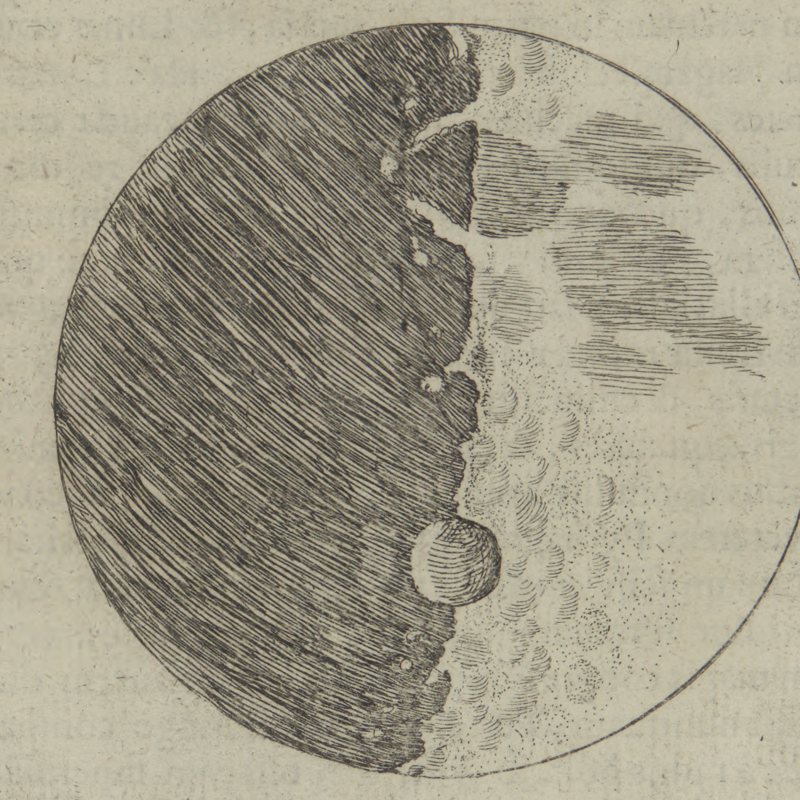
On a January night in 1610, a professor of mathematics at Padua pointed a homemade telescope at Jupiter and saw three small stars beside it. He wrote down where they were and came back the next night to see whether they had moved. They had. Within weeks he had found four of them, moons circling another planet, and published them in The Starry Messenger. Within a year he had a court title in Florence and a philosopher's salary.
Between October and December 1610 he watched Venus go from a small round disc to a perfect half and begin to thin, like the moon. That finished the old system of Ptolemy, which put the earth at the centre with everything circling it: in Ptolemy's arrangement Venus could never show a full face.
But it did not prove that the earth moves. A third system, Tycho Brahe's, kept the earth still, sent the sun round it, and sent the planets round the sun. Seen from the earth, it predicts exactly what Copernicus predicts. Every single thing the telescope revealed fitted both. That is the problem the whole story turns on.
1616: until it is shown me
In 1615 Cardinal Robert Bellarmine, the Church's leading theologian, set out the terms in a letter. Treating the moving earth as a convenient hypothesis for calculating was fine. Claiming it was literally true would need a real demonstration, and until it is shown me, he would not believe there was one. If one were produced, Scripture would have to be reread.
In February 1616 eleven theologians declared the sun-centred system foolish and absurd in philosophy. The pope ordered Bellarmine to warn Galileo to abandon it, and only if he refused, to give him a formal order not to hold, teach or defend it in any way. A note in the file, dated the next day, records the formal order as given. Nothing in the file records a refusal. Bellarmine then gave Galileo a signed certificate saying only that the opinion could not be defended or held.
Two papers, saying different things. Seventeen years later, the trial lived in the gap between them.
The book
In 1632 Galileo published his Dialogue Concerning the Two Chief World Systems. Rome had licensed it on conditions: it was to treat the moving earth as a hypothesis only, and the ending was to carry the pope's own argument, that God could produce the world we see by means no one could guess, so that nothing observed could ever prove how it is really made.
Galileo obeyed. He put the argument on the last page, in the mouth of Simplicio, the plodding defender of Aristotle who has lost every exchange for four hundred pages. Nobody in Rome needed to be told whose argument it was.
And the book's great proof that the earth moves was the tides. The earth's daily spin and its yearly orbit, Galileo argued, combine to jerk the seas back and forth like water in a barge. It is wrong at the first step. It would give one high tide a day, where the sea gives two, and the real cause is the moon, as Kepler had said and Galileo had scorned. The report the Inquisition commissioned on the book noticed the wrong number of tides.
The trial, 1633
The charge was not that the earth moves. It was that Galileo had broken the order of 1616 by publishing the book.
The case was settled less by the hearings than by a conversation. In April 1633 the prosecutor, Vincenzo Maculano, wrote to the pope's nephew that he had talked with Galileo yesterday after dinner and brought him round to admitting his error. Three days later Galileo told the court that, reading his book again as if another man had written it, he saw he had made the case too strong, and put it down to vain ambition.
On 21 June he was questioned about his intentions and, as a decree of 16 June had ordered, threatened with torture. The minute records words only. He was not taken to the instruments. On 22 June, aged sixty-nine, he was sentenced as vehemently suspected of heresy, made to abjure on his knees, and ordered confined. Ten cardinals were named as judges. Seven signed.
The sentence was then sent to every nuncio and inquisitor in Europe, so that it would reach every professor of philosophy and mathematics. About fifty acknowledgements came back, from Vienna to Madrid.
Afterwards
He was sent first to the Archbishop of Siena, then to his own house at Arcetri, outside Florence, near the convent where his daughter, Sister Maria Celeste, lived. Going blind, he finished his last book, Two New Sciences, which laid the foundations of physics, and had it carried out of Italy and printed at Leiden in 1638. He died at Arcetri on 8 January 1642. Rome discouraged a monument, and his body was put in a room in a bell-tower.
And yet it moves appears in no document from his lifetime. The first time anyone printed it was in London in 1757, more than a century after the trial.
Who was right
Galileo was right about the earth. He never had the proof. Nobody did until 1729, when the English astronomer James Bradley found that every star shifts slightly through the year in the direction the earth is moving, something a still earth cannot produce. Galileo's book left the Index of forbidden books in 1835, and in 1992 Pope John Paul II addressed the case, following the report of a commission he had set up in 1981.
Which leaves the question underneath it all, the one Galileo sharpened for everyone who came after and then answered badly for himself: what counts as proof?
Everything on this page comes from Galileo Galilei: What Counts as Proof, which is built from the trial file, the letters on both sides and the ambassador’s dispatches, and says in its notes where each fact comes from.
This site is not connected with the Broadway production of Galileo.